
 English
When choosing water purification equipment, the filter element is its core and soul. Faced with the promotion of "high flow folding filter" and "ordinary filter" in the market, consumers often feel confused. The relationship between these two is not simply an upgrade, but a technological path that fundamentally differs in design philosophy, performance, and applicable scenarios. Understanding their differences is the key to making wise choices.
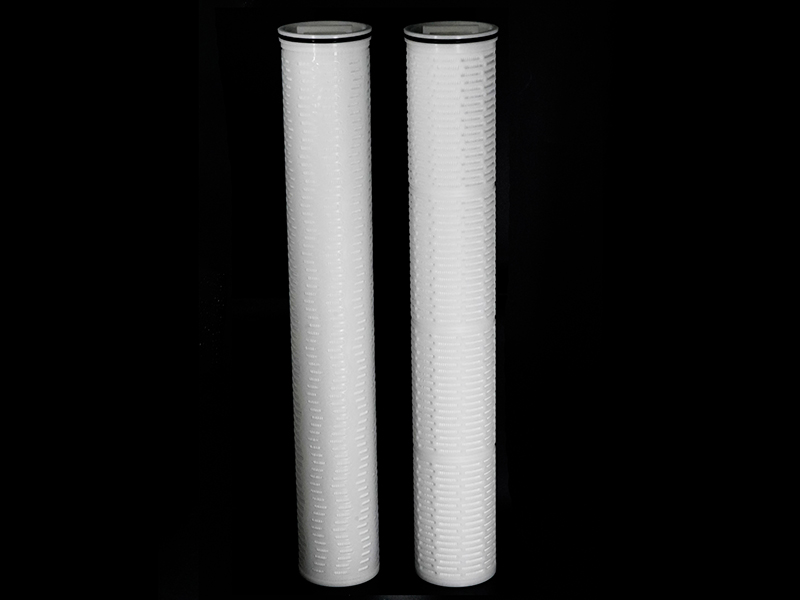
Simply put, if a regular filter element is compared to a brick wall that needs water to "hit", then a high flow folding filter element is a "three-dimensional maze" with huge and precise internal channels, whose efficiency and capacity are incomparable.
Core structure: The world of difference between simple filling and precise folding
This is the root of all differences.
Ordinary filter cartridges, such as PP cotton or granular carbon, have relatively simple structures. PP cotton filter cartridge is made by randomly winding polypropylene fibers together through melt blown technology, relying on the gaps between the fibers for filtration, similar to a fluffy ball of cotton. The granular carbon filter simply fills activated carbon particles in a plastic shell, and water flows through the gaps between the particles. The commonality between these two structures is that the filtering path is random and inefficient.
In contrast, high flow folding filters represent a precise engineering design. It adopts a flat filter membrane with specific precise pore size, which is repeatedly folded through high-tech technology to form a dense wrinkled structure similar to accordion bellows or louvers. These folds are firmly wrapped by an inner and outer support layer, forming an efficient cylinder. You can imagine it as a precision book rolled into a cylindrical shape, with each page filled with even micropores, thus achieving a perfect filtration area.
Performance: Multi dimensional gap between basic filtering and efficient all-around
The difference in core structure directly leads to a huge performance gap.
Firstly, in terms of filtration area and flux, ordinary filter cartridges have limited effective filtration area due to structural limitations. At the same size, its water circulation is relatively small, and it takes longer to fill a cup of water. The core advantage of the high flow folding filter element lies in its folding design, which increases the effective filtering area in a geometric progression, reaching three to five times or even higher than ordinary filters of the same size. This means that it can provide a very large water flow rate with a more compact volume, meeting the urgent need for fast water discharge in modern households.
Secondly, in terms of filtration accuracy and consistency, the fiber distribution of ordinary PP cotton filter cartridges is random, with uneven pore size, which may result in "large pores" causing a small amount of tiny impurities to penetrate, and the filtration accuracy is relatively broad and unstable. The high flow folding filter adopts homogeneous membrane material, and its pore size is precisely controlled to achieve uniform distribution height. This means that it can provide consistent and reliable filtration accuracy, such as ensuring stable retention rates for small substances such as bacteria and colloids, making the filtration effect more predictable and trustworthy.
In terms of pollutant carrying capacity and service life, ordinary filter cartridges mainly rely on deep interception. Impurities will quickly clog the inside of fibers or particles, filling the limited space and causing a rapid drop in water pressure, requiring frequent replacement. The large surface area of the high flow folding filter allows pollutants to be evenly distributed on the surface and shallow layers of each fold, rather than quickly blocking the core channel. This makes its pollutant carrying capacity far exceed that of ordinary filters, significantly extending its service life, not only reducing replacement frequency, but also lowering long-term maintenance costs.
Application scenarios and cost considerations: different choices between economic applicability and long-term effectiveness
Based on the performance differences mentioned above, the applicable scenarios of the two naturally differ.
Ordinary filter cartridge is an economical choice for entry-level household water purifiers or as a first stage pre filtration for reverse osmosis water purifiers. It is suitable for basic filtration environments with acceptable water quality and low flow requirements. Its single purchase cost is relatively low, but due to its frequent replacement, the long-term comprehensive usage cost may not necessarily be low.
The high flow folding filter is positioned in the market. It is a choice for household whole house water purification systems, high flow kitchen ultrafiltration water purifiers, commercial direct drinking machines, as well as medical, food, and electronics industries. It perfectly solves the industry problem of "requiring both high-precision filtration and high flow effluent". Although its single unit purchase cost is relatively high, the long-term service life, stable and reliable filtration effect, and superior water experience it brings constitute a better long-term use value.
In summary, high flow folding filters are not a simple replacement for ordinary filters, but a technological leap. It has achieved comprehensive breakthroughs in the three core dimensions of flow, accuracy, and lifespan through precise design that trades space for performance. If you are pursuing faster water collection speed, more stable filtration effect, and longer replacement cycle, then the high flow folding filter element is undoubtedly a more advanced and efficient choice. For users with limited budgets and only basic filtration needs, ordinary filter cartridges still retain their economic and practical market value.


