
 English
An efficient activated carbon filter is far from a simple 'black stick'. Its performance core is deeply embedded in every manufacturing process from raw material selection to molding. These precise processes together determine the strength of the filter's adsorption capacity, the level of filtration accuracy, and the length of its service life.
1: The choice of raw materials - laying the foundation for performance
Everything starts with choosing the 'physical body'. The raw materials for activated carbon filters are mainly divided into three categories:
Coconut shell activated carbon is highly regarded. It originates from natural coconut shells and is known for its high density and well-developed natural microporous structure. This innate advantage makes the activated carbon produced by it have a developed structure mainly composed of micropores, which is particularly good at adsorbing small molecular impurities in water, such as residual chlorine, and has low ash content. It is clean and safe, and is regarded as the superior choice for household water purification.
Secondly, the widely used coal based activated carbon is mostly processed from anthracite or lignite. The proportion of large pores in its pore structure is relatively high, and it performs well in treating complex industrial wastewater. However, when used for purifying household drinking water, its purity and adsorption efficiency for small molecule substances are usually slightly inferior to coconut shell charcoal.
In addition, there are also fruit shell charcoal or wood charcoal made from peach shells, sawdust, and other raw materials, which have properties between coconut shells and coal, and are a choice that balances performance and cost.
2: The awakening of the soul - the journey of activating the creation of pores
Having a 'physical body', the next step is to inject it with a 'soul' - that is, to create a huge specific surface area and intricate pore network through the process of 'activation'. The mainstream activation process can be divided into two main paths:
One is the physical activation method, also known as the water vapor method. This process first carbonizes the raw materials at high temperatures to remove volatile substances, and then activates them by introducing superheated steam at higher temperatures. Water vapor selectively "etches" the surface of carbon, thereby ablating countless tiny pores. This method is completely free of chemical additives, ensuring the purity of the activated carbon product, especially suitable for the high safety requirements of drinking water and food fields.
The second method is chemical activation. This method involves mixing raw materials with chemical reagents such as phosphoric acid and zinc chloride, and then performing one-step activation at a relatively low temperature. Chemical reagents can promote the decomposition of non carbon components and the formation of pores in raw materials. The activated carbon prepared by this method has well-developed pores, but it must undergo extremely strict acid and water washing to completely remove chemical residues, otherwise there is a risk of secondary pollution, so it is mostly used in industrial scenarios.
3: Forging of Form - The Art of Forming from Powder to Filter Cartridge
Powdered activated carbon cannot be directly used for filtration, but is given a stable and practical form through molding processes. This is also a crucial step in distinguishing the type and performance of filter cartridges.
The common form is granular activated carbon filter cartridge. It has a simple process of directly filling activated carbon particles of different sizes into plastic shells. Its advantages are high water flow rate and low cost. But the drawbacks are also obvious: water flow can easily create "shortcuts" between particles, resulting in some carbon particles not being fully utilized, known as the "channel effect"; At the same time, there may be slight carbon powder leakage during initial use.
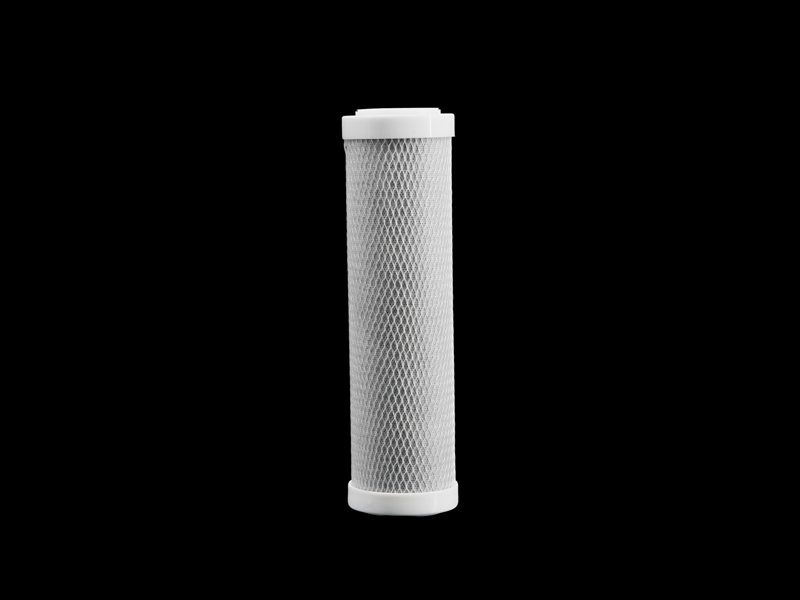
A more advanced and common type is the compressed activated carbon filter cartridge. It mixes fine activated carbon powder with food grade polymer binder and is tightly compressed into a solid filter rod under high temperature and pressure. This structure completely eliminates the channel effect, forcing water flow to penetrate countless pores inside the carbon rod, ensuring sufficient contact between pollutants and activated carbon. Not only that, the dense structure also endows it with the ability to intercept particle impurities such as rust and sediment, achieving dual effects of adsorption and filtration without worrying about carbon powder leakage.
The best one is undoubtedly the sintered activated carbon filter cartridge. It can even melt activated carbon powder and thermoplastic material at the critical point through high-temperature sintering technology without adding adhesive, forming a sturdy and internally interconnected network structure. This type of filter has high strength, can withstand large water pressure impacts, is not easy to break, and its pore structure has been precisely designed to achieve a certain level of adsorption efficiency, filtration accuracy, and structural stability.
In addition, there is a fiber activated carbon filter that attaches nanoscale activated carbon to organic fibers, making them into cloth or felt like materials. Its major feature is fast adsorption speed, as pollutants do not need to penetrate deep into the particles and can be captured on the fiber surface, but its cost is relatively high.
In summary, the birth of a high-quality activated carbon filter is a journey of ingenuity and craftsmanship. From selecting coconut shell raw materials, to using pure physical steam activation, and then forming through high-pressure compression or high-temperature sintering technology, every step of the process is refined to ensure that every drop of water flowing into your cup is clear, sweet, and safe.


