
 English
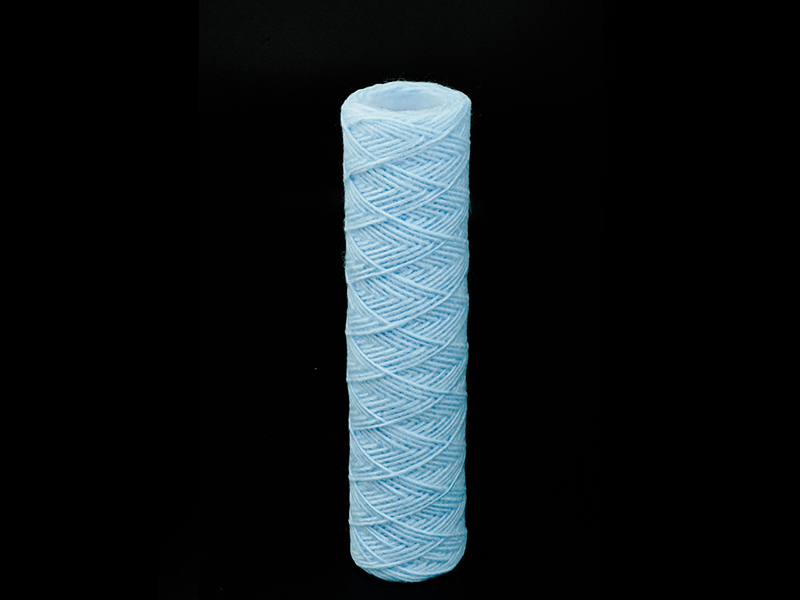
Wire wound filter element, as a classic and widely used deep filtration element, its core function is to effectively remove suspended particles, impurities, and some microorganisms in the liquid through physical interception. It is like a "sentinel" or "roughing workshop" of a filtration system, providing preliminary clean fluid for subsequent fine filtration processes or end use.
1、 Core structure and working principle: why is it so effective?
To understand its function, it is necessary to first understand its unique structure: Structure: usually made of textile fiber threads (such as polypropylene PP, cotton, glass fiber, etc.) wrapped precisely around a porous skeleton (such as polypropylene, stainless steel) according to specific winding rules and tension. This winding method forms a gradient filtering layer from the surface to the inside, from loose to dense.
Working principle: Deep filtration and gradient interception: When liquid flows from the outside to the inside of the filter element, larger particles are first intercepted by the loose part of the outer layer. As the liquid infiltrates inward, the filtering channel becomes narrower and tighter, and finer particles are successfully captured by the middle and inner layers. Three dimensional adsorption: Unlike surface filtration (such as filter membranes), the entire volume of the wire wound filter element is involved in filtration. Impurities are not only trapped on the surface, but also 'adsorbed' inside the criss crossing fiber maze. High pollutant holding capacity: It is precisely this deep and gradient structure that allows the wire wound filter element to accommodate a large amount of pollutants, unlike surface filters that are easily clogged quickly. Therefore, its pollutant holding capacity is very large and its service life is long.
2、 Main functions and functions
Based on the above principle, the wire wound filter element specifically plays the following key roles: efficiently removing suspended solid particles
Target objects: visible or invisible suspended solids such as rust, sediment, sludge, algae, asbestos fibers, colloids, etc.
Effect: It can significantly reduce the turbidity of the liquid, making it clear and transparent. This is its core and fundamental role.
As a pre filtration protection for precision filtration, wire wound filter cartridges are often used as "security filters" before reverse osmosis (RO) systems, ultrafiltration (UF) devices, or ion exchange resins.
Function: To remove particles that may scratch, block, or contaminate expensive precision components in advance, thereby protecting RO membranes, ultrafiltration membranes, and resins, extending their service life, and reducing system operation and maintenance costs.
Preliminary microbial filtration can effectively remove parasitic eggs such as flagellates and cryptosporidium, as well as most bacteria (usually larger than 0.2 microns in size) from water using high-precision wire wound filters (such as 1 micron and 5 microns). Although it cannot fully achieve the level of "sterilization", it can significantly reduce microbial load.
Protect critical equipment by installing it at the front end of water pumps, nozzles, heat exchangers, measuring instruments, and other equipment to prevent solid particles from causing wear, corrosion, or blockage, ensuring stable operation of the equipment and reducing failure rates.
3、 Summary of Core Features
Advantages: Large pollutant absorption capacity: The deep filtration structure makes its "appetite" amazing, several times that of surface filter cartridges. Low cost: With mature production technology and affordable prices, it is a highly cost-effective pre-treatment option. Wide chemical compatibility: The wire wound filter element made of polypropylene material can withstand various acids, alkalis, and organic solvents. No medium detachment: The high-quality wire wound filter uses fibers with inherent adhesion, which will not cause secondary pollution due to fiber detachment.
Limitations: Belonging to deep filtering: unable to guarantee accuracy, there may be a small amount of tiny particles "penetrating" the filter layer. Unable to clean and regenerate: usually disposable, it needs to be replaced directly after blockage.
4、 Main application areas
The function of the wire wound filter determines its wide application scenarios: in the field of water treatment, household/commercial water purifiers are used as initial or secondary pre-treatment filters. Industrial water: Pre treat groundwater, river water, and lake water to provide makeup water for boilers and cooling towers. Wastewater treatment: used for security filtration after effluent. Food and beverage industry: Clarify and filter syrup, beverages, beer, edible oil, etc. Chemical industry: filtering chemical reagents, solvents, and separating catalysts. Electroplating and coating industry: Filter electroplating solution and paint, remove impurities, and ensure the quality of plated parts and coatings. Agriculture and Horticulture: Used for filtering drip irrigation systems to prevent clogging of drip heads.
summary
The wire wound filter may not be a high-precision member of the filtration family, but it is undoubtedly a reliable, economical, and durable "deep guard". Its main role is to take the lead, providing a clean and safe preliminary environment for subsequent processes or terminal devices through its enormous pollutant absorption capacity and gradient filtering technology. When choosing a filtration solution, when faced with conditions such as high suspended solids, large impurities, and the need for cost control, a wire wound filter cartridge is often an ideal choice.


